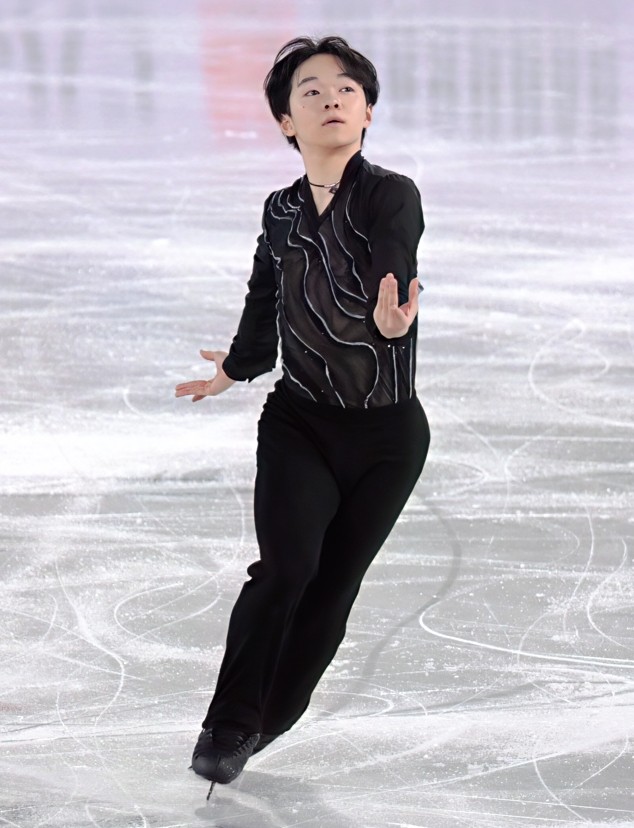
Yuma Kagiyama's Height: A Deep Dive into His Stature and Its Impact on Elite Figure Skating
Yuma Kagiyama, the prodigious Japanese figure skater, has captivated audiences worldwide with his electrifying performances, remarkable artistry, and a consistent ability to land some of the sport's most challenging jumps. As he continues to etch his name into the annals of figure skating history, many observers and analysts often find themselves discussing various facets of his technique and physical attributes. One such characteristic that frequently piques curiosity is his physical stature. At approximately
5'3" (160 cm), Kagiyama presents a fascinating case study in how world-class talent can thrive, and even excel, despite being notably shorter than many of his top competitors. This article delves into Yuma Kagiyama's height, compares it to other elite male skaters, and explores the unique interplay between his stature and his formidable presence on the ice.
Kagiyama's Stature: More Than Just a Number
Born on May 5, 2003, in Karuizawa, Yuma Kagiyama has quickly ascended the ranks of international figure skating, representing Japan with distinction. While some sources have listed his height at 155 cm (approximately 5'1"), his ISU (International Skating Union) bio often cites him at 160 cm (5'3"), which is the measurement we will focus on for consistency with the popular perception and the title of this analysis. This specific
Kagiyama height places him on the lower end of the spectrum for male athletes in a sport often dominated by individuals with a more imposing physical presence.
However, reducing Kagiyama's abilities to a mere measurement would be a disservice to his immense talent. His relatively compact frame brings with it a unique set of biomechanical properties that, when expertly harnessed, contribute significantly to his distinctive skating style. Rather than viewing his stature as a limitation, it's more accurate to understand how he leverages it to his advantage, transforming what might be perceived as a physical constraint into a finely tuned instrument for executing intricate maneuvers and powerful jumps.
Comparing Kagiyama Height to Elite Rivals
To truly appreciate the significance of Yuma Kagiyama's height, it's helpful to place it in context alongside some of his most formidable competitors on the international stage. The elite men's field in figure skating is a tapestry of diverse body types, each bringing their own strengths to the ice.
Consider these comparisons:
*
Ilia Malinin (USA): A rising star known for his groundbreaking quad axel, Malinin stands at an imposing
5'9" (175 cm). This six-inch difference between him and Kagiyama is substantial in a sport where precision and aerial dynamics are paramount.
*
Nathan Chen (USA): The Olympic champion and a dominant force for years, Chen stands at
5'6" (168 cm). While not as tall as Malinin, he still enjoys a three-inch height advantage over Kagiyama.
*
Daniel Grassl (Italy): Another powerful jumper and consistent competitor, Grassl shares Malinin's stature at
5'9" (175 cm).
*
Andrew Torgashev (USA): An emerging talent from the United States, Torgashev measures in at
5'7" (170 cm).
These comparisons clearly illustrate that Yuma Kagiyama is indeed "far smaller than many of his foes." This difference isn't merely cosmetic; it fundamentally alters the biomechanical equations involved in generating power, achieving lift, and completing rotations during jumps, as well as influencing the visual aesthetics of spins and transitions. For Kagiyama, success isn't about matching his rivals' physical dimensions, but about optimizing every other variable to compensate and, ultimately, surpass them.
The Physics of Flight: How Stature Intersects with Jump Mechanics
Figure skating, at its core, is a beautiful application of physics. Every jump, spin, and glide adheres to principles of motion, force, and balance. For a skater like Yuma Kagiyama, whose height is below average for elite male competitors, mastering these principles becomes even more critical.
Take, for instance, his formidable Quad Flip. Advanced analysis of his execution reveals impressive capabilities:
*
Huge Flight Time: Kagiyama achieves a remarkable flight time of
0.720 seconds on his quad flip. This extended airtime is crucial for completing multiple rotations and is a testament to the vertical power he generates despite his stature.
*
Good Angular Velocity: His angular velocity of
24.933 rad/s during the "snap" phase is excellent, indicating efficient rotation. This combination of significant airtime and rapid rotation allows him to complete his quad jumps cleanly.
However, the analysis also points to areas for optimization, particularly concerning the *takeoff angle*. Currently, Kagiyama's body axis forms an angle roughly around
20 degrees during takeoff. Experts suggest that an angle within the
13- to 15-degree range would be more optimal and efficient. This slight adjustment, seemingly minor, could significantly impact the overall execution and performance, potentially leading to even greater jump height and length. A more optimal takeoff angle could allow him to translate his impressive vertical force more effectively into both height and forward momentum.
Interestingly, despite his excellent flight time, a deeper look into the projectile motion formula (which defines the trajectory of a jump) suggests that the *length* of his jump should ideally be longer given his recorded height and flight time. This discrepancy hints at what analysts refer to as the "ineffectiveness of his draw" – the initial phase from the toe-pick until the actual takeoff. Improving the efficiency of this draw could unlock even greater jump length, complementing his already impressive flight height. For a comprehensive breakdown of this aspect, you can read more in
Unlock Yuma Kagiyama's Jump Height Potential: Quad Flip Takeoff Analysis and
Kagiyama's Quad Flip: Optimizing Takeoff Angle for Maximum Jump Height.
Advantages and Adaptations of a "Smaller" Skater
While some might perceive Yuma Kagiyama's height as a disadvantage, it brings several potential benefits and requires specific adaptations that can be honed into strengths:
*
Faster Rotation: A smaller body mass often translates to a lower moment of inertia. This means a skater like Kagiyama can potentially initiate and achieve rotational speed more quickly than a taller, heavier skater. This can be crucial for completing those high-rotation quad jumps.
*
Agility and Quick Transitions: A more compact frame can contribute to greater agility and quicker changes in direction, allowing for intricate footwork, seamless transitions, and rapid shifts in body position.
*
Lower Center of Gravity: While not universally true, a relatively shorter stature can sometimes contribute to a naturally lower center of gravity, which can enhance stability during spins and complex step sequences.
*
Emphasis on Precision: To compete with taller skaters who might naturally achieve greater visual height and length on jumps, a "smaller" skater must rely even more heavily on impeccable technique, precise timing, and maximal power generation. This often leads to a highly refined and efficient skating style. Kagiyama's commitment to technique is a clear example of this adaptation.
*
Artistic Impact: While taller skaters might convey grandiosity, shorter skaters can often bring a unique brand of speed, sparkle, and dynamic energy that is equally compelling, highlighting intricate details and rapid-fire elements.
Kagiyama's Success Story: Defying Conventional Norms
Yuma Kagiyama's impressive prize list and results speak volumes about his ability to transcend physical measurements. He competes in individual men's events and has also contributed to mixed team competitions, showcasing his versatility and reliability. Some of his notable victories include:
*
NHK Trophy in 2023: A significant victory demonstrating his continued prowess and competitive edge.
*
Internationaux de France in 2021: Another testament to his consistent performance at the Grand Prix level.
Representing the Kanagawa FSC, Yokohama club, Kagiyama's career trajectory underscores a vital truth in elite sports: while physical attributes play a role, they are not the sole determinants of success. Dedication, relentless training, innovative coaching, and an unwavering belief in one's potential can overcome perceived physical limitations. Yuma Kagiyama serves as an inspiration, proving that a skater's impact is measured not by their height in centimeters or inches, but by the magnitude of their skill, artistry, and competitive spirit.
Conclusion
Yuma Kagiyama's height, at approximately 5'3" (160 cm), certainly places him among the shorter male competitors in elite figure skating. However, this characteristic is far from a hindrance. Instead, it forms part of the unique physical canvas upon which he paints his masterpieces on ice. By mastering the intricate physics of jump mechanics, optimizing his takeoffs, and leveraging the inherent advantages of a compact frame for rotation and agility, Kagiyama not only competes with but frequently triumphs over taller rivals like Ilia Malinin, Nathan Chen, and Daniel Grassl. His story is a powerful reminder that in figure skating, as in life, true greatness is defined not by physical dimensions, but by the relentless pursuit of excellence, the mastery of technique, and the indomitable spirit to soar.